News
2026-03-07

Industry sources indicate that magnetic charging product shipments in the US have entered sustained double-digit growth driven by faster standards, broader device compatibility, and a pronounced consumer preference for convenience. Market channels from online marketplaces to big-box retailers and OEM accessory bundles are signaling steady attach-rate improvements, while product teams and analysts now prioritize interoperability and measurable speed metrics.
| Feature | Standard Wireless (Qi) | Magnetic Charging (Qi2/MagSafe) | User Benefit |
|---|---|---|---|
| Alignment Precision | Manual / Random | Auto-Magnetic Locking | Eliminates "dead spots" & failed charges |
| Charging Efficiency | 70% - 80% | 85% - 95% | Faster top-ups, less device heat |
| Peak Wattage | 5W - 7.5W (Standard) | 15W - 25W+ | Reduces charge time by ~40 mins |
| Connector Wear | N/A (Pad) | Zero physical friction | Extends device lifespan (port protection) |
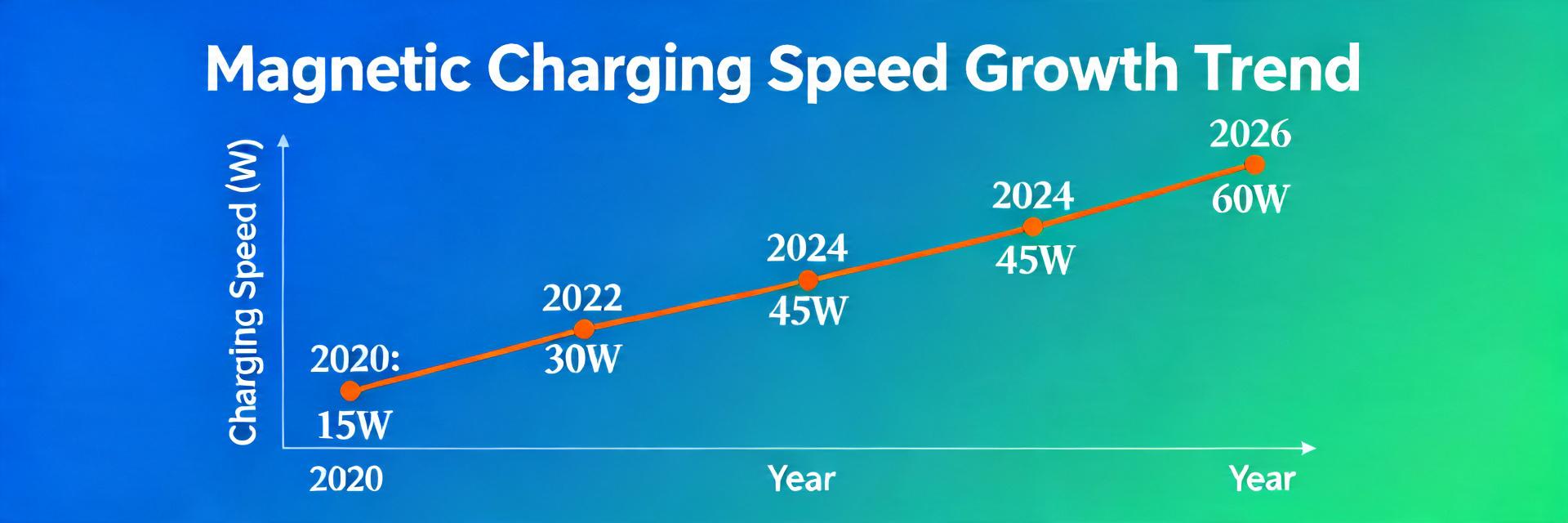
Point: The US market shows multi-channel volume growth for magnetic charging accessories. Evidence: Industry reports and retailer sell-through indicators consistently reference double-digit category growth ranges and stronger unit sales in online channels and bundled OEM offerings. Explanation: These signals suggest the segment is moving from niche aftermarket demand toward mainstream accessory budgets, with aftermarket snap-on adapters and OEM-integrated backs driving unit mix and revenue skew.
Point: Magnetic charging uses magnets to align electrical contacts or inductive coils for repeatable connection. Evidence: Common architectures include connector-based magnetic cables with pogo pins, magnetic inductive pads with alignment rings, and MagSafe-style coupling that blends alignment magnets with wireless power transfer. Explanation: Understanding form factors—snap-on cables, magnetic pads, dongles—helps teams plan mechanical tolerances, alignment magnet strength, and user experience trade-offs between convenience and power delivery.
Point: Adoption varies by device type and consumer cohort, with earbuds and wearables leading in attach rates. Evidence: Channel-level signals show early adopters within premium accessory buyers and fleet retrofit projects, while mainstream smartphone users adopt more slowly without OEM integration. Explanation: Accessory aftermarket demand and OEM bundling paths determine rapidity of adoption; aftermarket sell-through and replacement cycles offer leading indicators for broader market uptake.
Point: Charging speed for magnetic solutions depends on peak wattage capability and real-world alignment losses. Evidence: Benchmarks should include peak watts, time-to-50%, and time-to-80% under controlled conditions; real-world tests routinely show reduced average power due to misalignment and connector resistance. Explanation: Standardized test setups—consistent device conditioning, thermal monitoring, and repeated alignment scenarios—produce comparable charging speed data and reveal practical performance gaps versus wired solutions.
Senior Power Systems Engineer
"While 15W is the marketing headline, the real winner in magnetic charging is the Thermal Throttling Curve. A well-designed PCB with high-quality decoupling capacitors near the induction controller can maintain peak speeds for 20% longer than budget alternatives. For engineers, I always suggest prioritizing Foreign Object Detection (FOD) calibration—it's the difference between a satisfied user and a safety hazard."
Point: Compatibility with prevailing wireless and PD frameworks is essential for market acceptance. Evidence: Teams should map Qi2-type compatibility, USB Power Delivery signaling implications, and connector pinout expectations when designing magnetic couplers. Explanation: A pre-launch compatibility matrix and a recommended device test list covering major OS ecosystems and chipset families reduce launch risk and ensure smoother interoperability and consumer confidence.
Typical Magnetic Coil Alignment Strategy for Automotive Dash-Mounts.
Point: Thermal and mechanical robustness determine field reliability and warranty exposure. Evidence: Design controls—magnet adhesion tolerances, FOD (foreign object detection), thermal throttling strategies, and overcurrent protection—are frequently cited in failure-mode analyses. Explanation: Recommended testing includes thermal cycling, drop and torque durability, and MTBF modeling to prioritize improvements that lower return rates and field-failure incidents.
Point: Different device archetypes capture distinct value from magnetic charging. Evidence: Earbuds and wearables benefit from fast reconnect and convenience, while phones trade power density for convenience unless OEM-integrated power pathways are provided. Explanation: Product teams should align price points and design trade-offs—such as magnetic case thickness and thermal headroom—to target the user scenarios most receptive to adoption.
Point: Automotive and public deployments require ruggedness and integration with billing or payment systems. Evidence: In-vehicle mounts, fleet retrofits, and public kiosks call out anti-vandalism measures, connector retention specs, and software hooks for usage accounting. Explanation: These segments introduce longer replacement cycles and higher reliability requirements, making certification and field-testing priorities for scale deployment.
Point: A focused pre-launch checklist accelerates market readiness. Evidence: Critical items include spec sheets for maximum supported watts, alignment tolerance bands, interoperability tests, EMC and safety certifications, plus pilot shipment KPIs. Explanation: Quick wins—clear labeling of supported devices/watts, firmware fallbacks, and bundled demos—reduce returns and increase early retail conversion.
Point: Educating consumers on compatibility and expected charging speed reduces hesitation. Evidence: Messaging frameworks that address safety, average in-use charge times, and compatibility checks improve conversion in both online and in-store environments. Explanation: Retail KPIs to track include conversion lift from demo units, return rates by SKU, and average order value when accessories are bundled with device purchases.
Magnetic charging is moving from niche convenience toward mainstream accessory tech across phones, wearables, and automotive deployments. The critical differentiator will be measurable charging speed and cross-device interoperability, which require standardized benchmarks and disciplined pre-launch testing.
What is magnetic charging adoption risk for a new accessory?
Adoption risk centers on compatibility and consumer expectations. Mitigation steps include publishing supported-device lists and offering clear return policies to build trust.
How should teams benchmark charging speed before launch?
Use standardized lab setups recording peak watts, time-to-50%, and time-to-80% compared against wired baselines to set realistic user expectations.




{{ boxName }} ({{ dataList?.length || 0 }} Items)
{{ val.manufacturer || val.en_manufacturer || '' }}
auto.lang_Quantity: {{ val.quantity }}
auto.lang_null