
News
2026-03-07

Latest datasets show DC fast-charging ports in the U.S. grew roughly 24% year‑over‑year, pushing public charging counts toward the mid‑80,000s. Growth concentrated on freeway corridors and commercial fleet depots, outpacing rural deployment and creating urgent capacity and permitting bottlenecks. This report quantifies station growth, unpacks installation and operating costs, and offers actionable recommendations for utilities, site hosts, and policymakers.
Understanding the present network requires clear definitions. Public DC fast charging (DCFC) refers to high‑power stations designed for short dwell times. Clarity on kW tiers is essential for translating technical power into user-centric charging speed.
| Tier | Power (kW) | User Benefit (Dwell Time) |
|---|---|---|
| Low DCFC | 50–100 kW | Quick Stop: 20-40 min (ideal for grocery runs) |
| Mid DCFC | 150–250 kW | Express: 10-25 min (standard road trip break) |
| High DCFC | 350+ kW | Ultra-Fast: 5-15 min (comparable to gas fueling) |
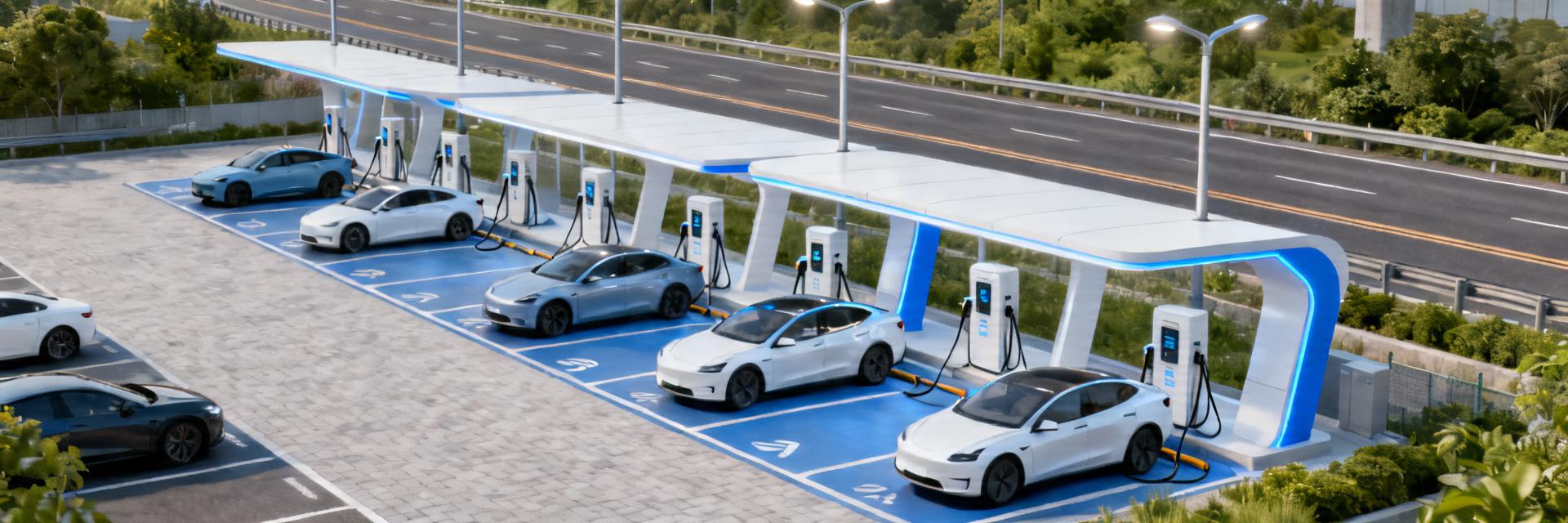
While national port counts approach 85,000, deployment remains uneven. To better understand the landscape, we compare standard market implementations against high-performance "Corridor Hubs."
| Metric | Standard Site (Retail/Urban) | Optimized Corridor Hub |
|---|---|---|
| Uptime Reliability | ~90-94% | 99% (Modular Redundancy) |
| Expansion Scalability | Limited by initial grid link | Pre-ducted for 2x capacity |
| Average Utilization | 2-5 sessions/day | 15-25+ sessions/day |
CAPEX varies by charger power and site complexity. Strategic selection of proximity to distribution capacity can reduce utility upgrade costs by up to 60%.
"The biggest mistake we see in site selection is underestimating the 'Make-Ready' timeline. Always perform a preliminary load study before signing a lease. If the local substation is capped, your $100k project turns into a $600k grid overhaul overnight."
Expert: Marcus V. Sterling, Senior Infrastructure Architect
A standardized sequence reduces permitting delays and cost surprises. Efficiency in the "Permit-to-Plug" timeline is the new competitive advantage.
[SVG Asset: Site Layout Optimization Diagram]
Hand-drawn sketch, not a precise schematic
EV fast charging deployment is expanding rapidly but unevenly. The path forward requires a three-pronged focus:
Forward looking: Adopting these standards will ensure a denser, more reliable network that bridges the gap between urban centers and rural corridors.




{{ boxName }} ({{ dataList?.length || 0 }} Items)
{{ val.manufacturer || val.en_manufacturer || '' }}
auto.lang_Quantity: {{ val.quantity }}
auto.lang_null