News
2026-03-07

Bluetooth 5.0 delivered headline improvements: multi-fold increases in practical range via coded PHY options (500 kbps and 125 kbps), a 2× PHY for higher raw throughput, and expanded advertising capacity for richer broadcasts. This report explains what those numbers mean in real devices, how range and throughput trade off, and how engineers should test and optimize BLE deployments, focusing on range, throughput, and operational insights.
Key focal metrics covered: range (link budget and sensitivity), throughput (application-layer bits/sec versus PHY rate), and practical BLE operational guidance for engineering teams preparing lab and field tests.
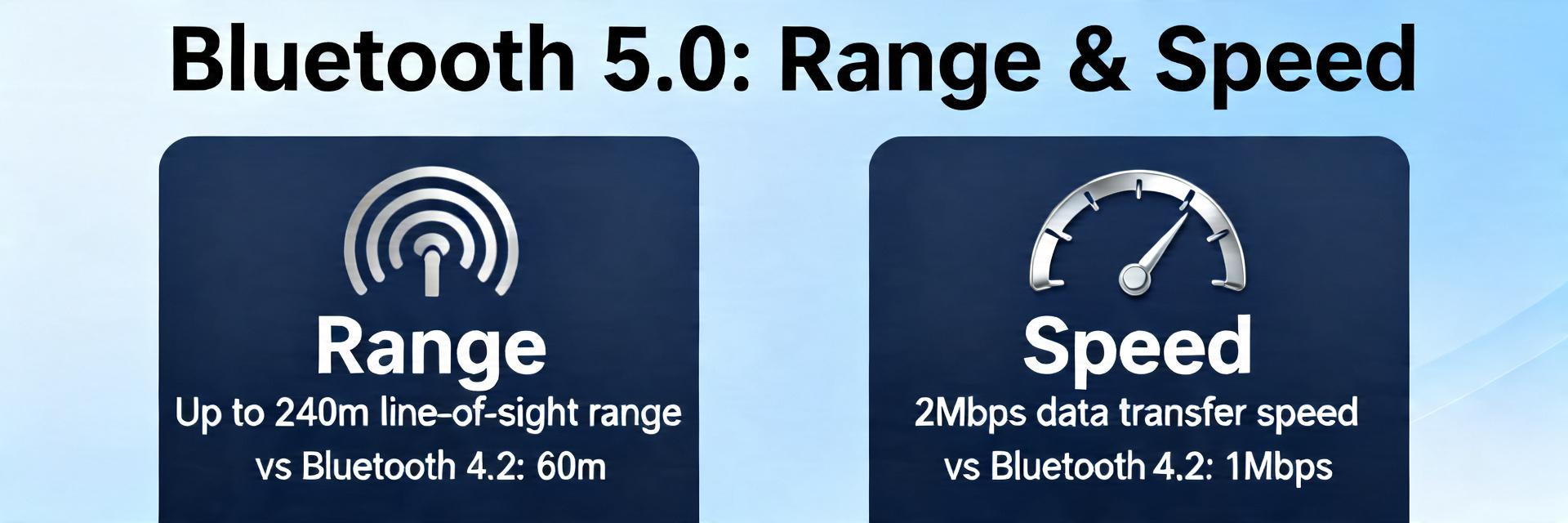
Point: The protocol added multiple PHYs and expanded advertising to change the practical envelope of BLE. Evidence: New PHY options include 2 Mbps (higher bit rate) and coded PHYs (S=2 for 500 kbps, S=8 for 125 kbps) that trade throughput for sensitivity. Explanation: PHY denotes the radio layer; coding increases time-on-air to improve receiver sensitivity (link budget), while higher PHY reduces air time but demands better SNR, directly affecting range and achievable throughput.
| PHY Mode | Raw Data Rate | Sensitivity Gain | Relative Range | User Benefit |
|---|---|---|---|---|
| LE 1M (Legacy) | 1 Mbps | 0 dB (Ref) | 1x | Universal compatibility |
| LE 2M | 2 Mbps | -3 to -5 dB | ~0.7x | Fast OTA updates, low power |
| Coded (S=2) | 500 kbps | ~3 dB | ~1.5x | Better indoor wall penetration |
| Coded (S=8) | 125 kbps | ~12 dB | Up to 4x | Extreme range (Long Range) |
Define essentials: PHY (radio physical layer), coding (redundant modulation to improve detectability), link budget (TX power + antenna gains − receiver sensitivity), MTU (max application payload per packet), connection interval (time between connection events), and advertising extensions (larger, periodic broadcasts).
Hand-drawn illustration, not a precise schematic
Point: Treat adopting new PHYs as a firmware/hardware decision. Evidence: Not all chipsets expose coded PHY or 2 Mbps without firmware support; stacks and host OS versions affect MTU and connection parameter control. Explanation: If your ecosystem includes legacy smartphones or stacks, plan fallbacks: negotiate PHY per-connection, test interoperability, and avoid assuming uniform support across devices.
Point: Coded PHYs trade throughput and latency for improved sensitivity. Evidence: S=8 coding (125 kbps) multiplies time-on-air, yielding several dB of coding gain; S=2 (500 kbps) is a mid-point. Explanation: Use link-budget logic: every +6 dB sensitivity improvement roughly doubles range in free space. Expect practical range gains of multiple times under clear line-of-sight, but throughput falls proportionally with coding and latency increases due to longer packets.
"The '4x range' claim is physically possible, but in urban environments, multipath interference often limits this to 2x or 2.5x. My advice: always verify your antenna matching. A poorly matched antenna can negate the 12dB coding gain of S=8 entirely. Don't skip the VNA measurements in your final enclosure."
Point: Controlled, repeatable tests reveal practical limits. Evidence: Measure RSSI, PER, and packet success rate across distances and environments. Explanation: Use open-field and representative indoor environments, fixed TX power, antenna configurations, and clear reporting of metrics per PHY.
Point: 2 Mbps PHY doubles raw bit rate but application throughput is lower. Evidence: Overhead from headers, ack/IFS, link-layer retransmissions, and ATT/GATT/MTU constraints reduce usable throughput. Explanation: Worked example: with 2 Mbps PHY, a 247-byte MTU and optimal connection interval, achievable application throughput often falls in the low-to-mid hundreds of kb/s rather than the 2 Mbps raw rate due to protocol overhead and timing gaps.
Point: Tune PHY and parameters to match use case. Evidence: Coded PHY improves reach; 2 Mbps improves bulk transfer. Explanation: Use these concrete recommendations: choose coded PHY for sparse telemetry at long range; choose 2 Mbps for firmware updates and large payloads.
Bluetooth 5.0 introduced coded PHYs and a 2× PHY that shift the design trade-space: coded modes extend reach at the cost of throughput and latency, while 2 Mbps enables faster bulk transfer but demands better SNR. The biggest real-world trade-offs are link-budget vs throughput and stack/OS constraints; engineers should first run A/B PHY tests with the methodology described and publish KPI-backed settings for product teams.
Coded PHY increases time-on-air and applies redundancy so the receiver can decode weaker signals, effectively improving sensitivity by several dB. That sensitivity gain maps to larger range using the link-budget equation, but it reduces maximum application throughput and increases latency.
Real-world application throughput is typically far below 2 Mbps due to protocol headers, inter-frame gaps, and stack limits. Expect hundreds of kb/s (typically 1.2 - 1.4 Mbps max) under optimized conditions.




{{ boxName }} ({{ dataList?.length || 0 }} Items)
{{ val.manufacturer || val.en_manufacturer || '' }}
auto.lang_Quantity: {{ val.quantity }}
auto.lang_null